Golf guide • Dominican Republic • La Altagracia Province

Golf in Punta Cana: Nicklaus and Fazio on the Caribbean Sea

Punta Cana, on the eastern tip of the Dominican Republic, brings together three courses laid across coral rock on the Caribbean shore: Jack Nicklaus's Punta Espada, Tom Fazio's Corales, home to a PGA Tour event, and the twenty-seven holes of La Cana by P. B. Dye. Golfers come for clifftop holes and turquoise coves, nine hours by direct flight from Paris. The best season runs from December to April.

Plan this tripUpdated

In 1969 the eastern tip of Hispaniola was nothing but a wild coast of coconut palms and coral rock. Frank Rainieri, a Dominican businessman, and Theodore Kheel, a New York lawyer, bought land there and named it Punta Cana. Half a century on, Punta Cana has its own private airport, run by the same group, and three first-rate courses within twenty minutes of one another, on ground where the sea is never far away.

Two estates share most of the golf. To the north, Puntacana Resort & Club, the estate founded by Rainieri and Kheel, offers Corales and La Cana. To the south, Cap Cana, a gated residential community, is home to Punta Espada, the Jack Nicklaus course people travel a long way to play. The big all-inclusive hotels of Bávaro, further north, are not our concern: our addresses are more intimate, from Tortuga Bay's thirteen villas to a Relais & Châteaux house at Cap Cana and a staffed villa at Casa de Campo.

Allow a week: the flight takes around nine hours, and the time difference is best put to work with dawn tee times. Four or five rounds are enough, with a day at sea out to Saona Island and, for those who wish, two nights at Casa de Campo, in La Romana, to play Pete Dye's Teeth of the Dog, opened in 1971.

The courses

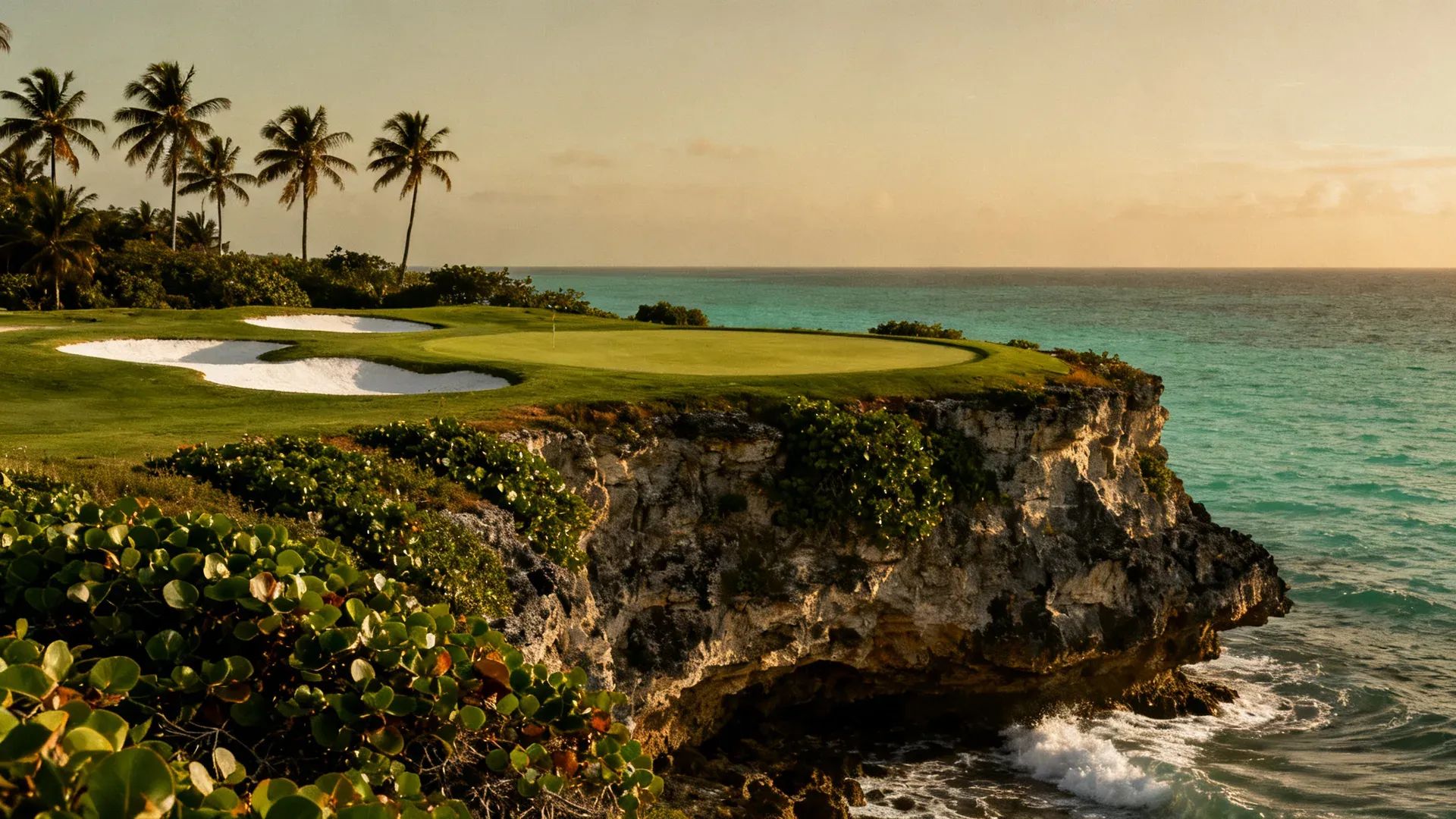
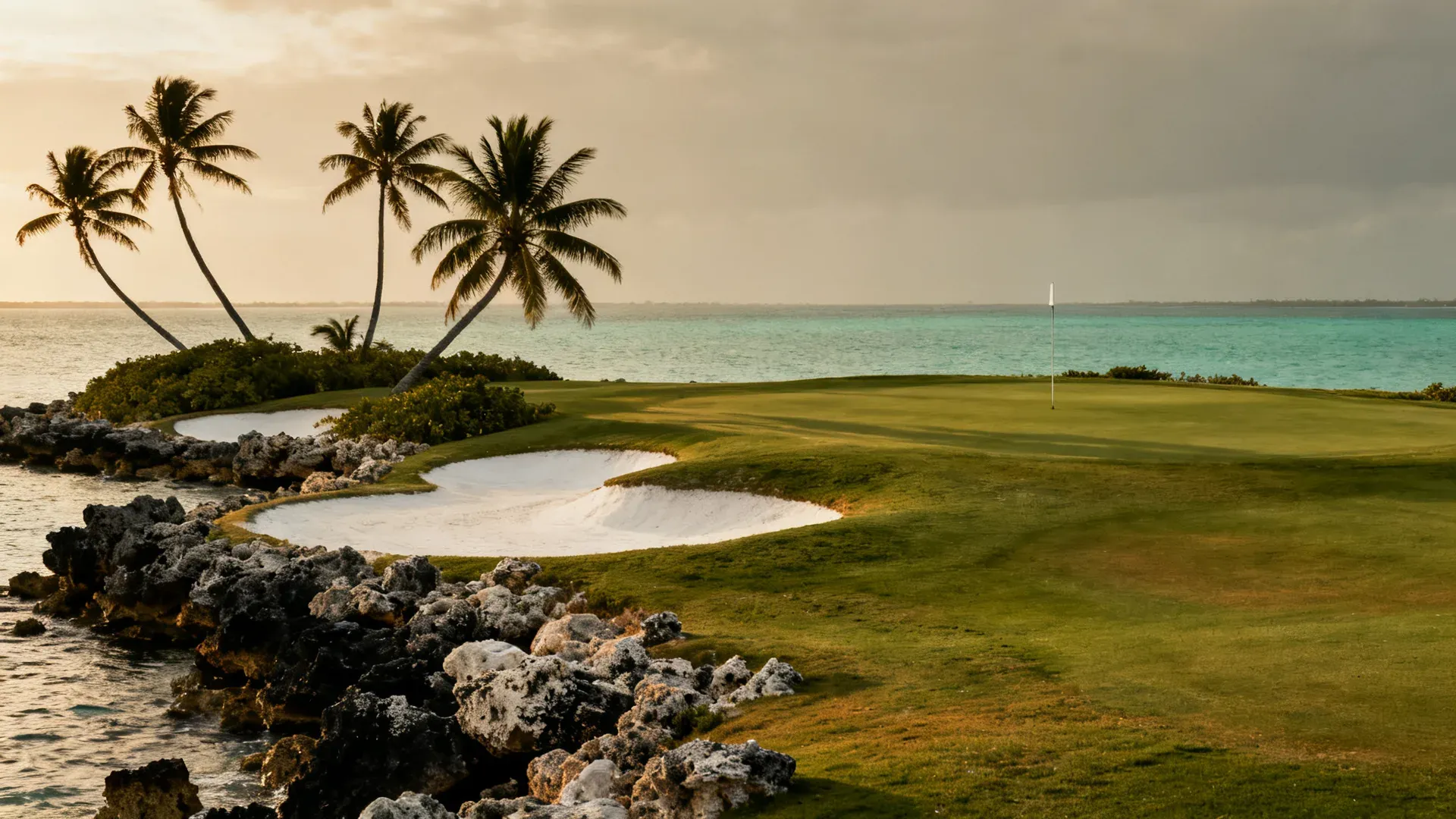
Seaside green ringed by white bunkers and coral rock, wind-bent coconut palms, turquoise sea in the distance

Punta Espada Golf Club

  • Architect: Jack Nicklaus
  • Opened 2006
  • 18 holes
  • Par 72

Opened in November 2006, Punta Espada is a Jack Nicklaus Signature design, the first of the three Nicklaus courses planned at Cap Cana. Eight holes run alongside the sea or carry over it; the rest thread between white limestone cliffs and sandy waste areas. The paspalum greens are known for their pace, and the trade wind weighs on every shot. From 2008 to 2010 it hosted the Champions Tour's Cap Cana Championship, which Fred Couples won in 2010 with a closing 62. It rewards confident ball-strikers and is played with a caddie, included in the green fee.

Signature hole. The 13th is a long par 3 played across an ocean inlet, with waves breaking at the foot of the cliffs: it is the shot people come to Punta Espada to hit.

Official website
Corales Golf Club

  • Architect: Tom Fazio
  • Opened 2010
  • 18 holes
  • Par 72

Designed by Tom Fazio and opened in 2010, Corales is the private course of Puntacana Resort & Club: 7,670 yards, par 72, six holes on the Caribbean, with cliffs, coves and old coral quarries. Since 2018 it has hosted the Corales Puntacana Championship, the first PGA Tour event played in the Dominican Republic. In September 2017 hurricanes Irma and Maria had flooded several holes; the greens were rebuilt in time for the first edition. It is a long test, for good players and anyone keen to follow in the pros' footsteps.

Signature hole. The Devil's Elbow, the stretch from the 16th to the 18th, runs along Corales Bay; at the 18th you must carry the ball over the cliff-lined bay.

Official website

La Cana Golf Club

  • Architect: P. B. Dye
  • Opened 2001
  • 27 holes

P. B. Dye, son of Pete Dye, laid out La Cana's first two nines, Tortuga and Arrecife, opened in 2001; a third, Hacienda, further inland, followed in 2012. Fourteen holes have sea views and four touch the water, with the Dye family's trademarks: railway sleepers, mounds and deep bunkers. The club presents La Cana as the first course in the Caribbean grassed with paspalum. More forgiving than Corales, it suits groups of mixed ability. Ask for Arrecife and Tortuga.

Signature hole. The 3rd on Arrecife, a 146-yard par 3 to an island green ringed with sand, pays tribute to the 17th at TPC Sawgrass, designed by the architect's parents.

Official website

Where to stay

Tortuga Bay

At the heart of Puntacana Resort & Club, the estate founded by Frank Rainieri and Theodore Kheel, Tortuga Bay has just thirteen villas, designed by Oscar de la Renta, Dominican-born and a co-owner of the estate since 1997. The hotel holds a Michelin Key. Balconies look out over La Cana and the beach; electric buggies and bicycles are provided for getting around the estate. Ask for a two-bedroom oceanfront suite, with direct access to the private beach.

Eden Roc Cap Cana

The first Dominican hotel admitted to Relais & Châteaux, in 2013, Eden Roc Cap Cana remains the country's only Relais & Châteaux house, with two Michelin Keys. Its interiors, inspired by the French and Italian Rivieras, are the work of Milanese designers Carlo Belgir and Marina Nova, and its kitchen also runs the restaurant at the Punta Espada clubhouse. Ask for one of the original suites with a private pool, set back from the beach in a tropical garden. The house also welcomes families.

Casa de Campo Resort & Villas

In La Romana, around fifty minutes from Punta Cana airport, Casa de Campo grew out of the ambition of Charles Bluhdorn, head of Gulf + Western, with interiors by Oscar de la Renta. Pete Dye designed Teeth of the Dog here, opened in 1971 and reserved for resort guests; restored by Jerry Pate, it reopened in December 2025. Rent a staffed villa: from the Classic category upwards, a butler handles light meals and the bar.

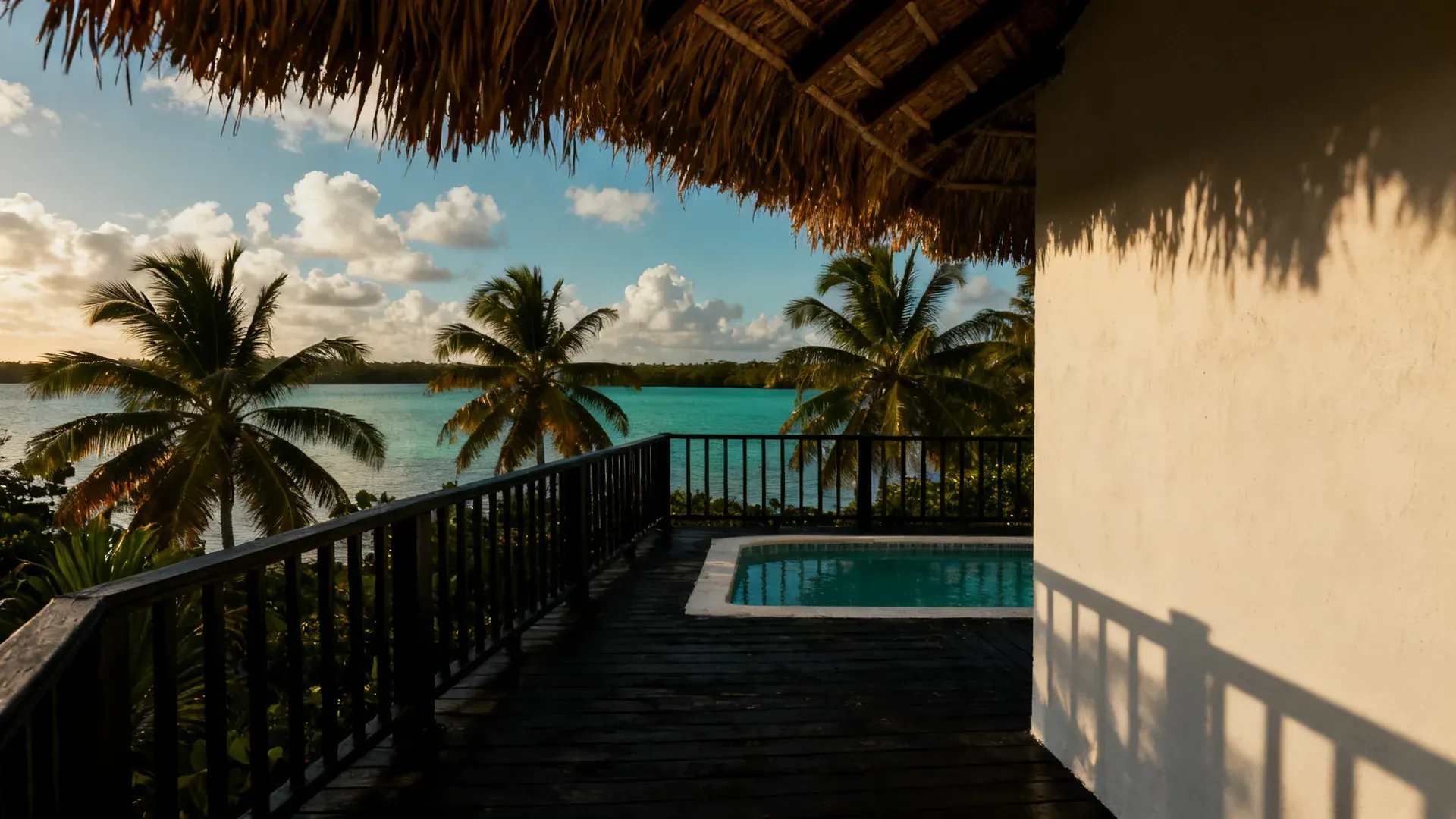
Wooden terrace under a palm-thatched roof, small pool and white wall, coconut palms facing a turquoise bay

Where to dine

La Yola

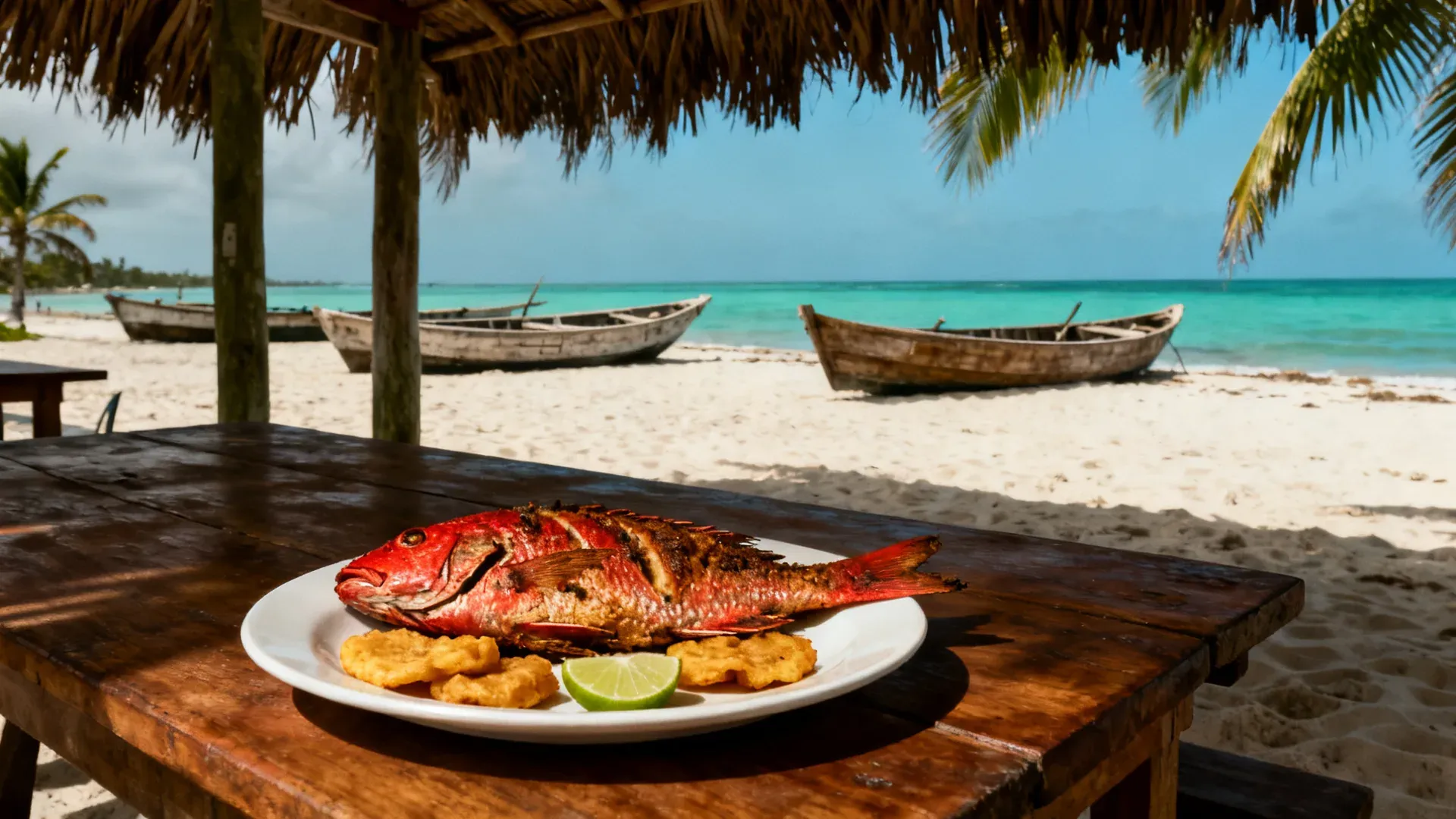
Founded and designed by Oscar de la Renta in 1996, La Yola takes the shape of a yola, the Dominican fishing boat, on a pier above the Puntacana Resort marina, under a palm-thatched roof. The cooking blends local fish, the Caribbean and the Mediterranean. Order the "Boca Chica" style red snapper, fried whole, with pigeon pea rice, coconut sauce and tostones. You come here first for the setting, at sunset.

Capitán Cook

On El Cortecito beach in Bávaro, Capitán Cook cooks fish and seafood bought from the area's small-scale fishermen, grilled on the sand in front of you. Its brick-and-straw structure did not withstand Hurricane Maria in 2017; it has since reopened. Lunch with your feet in the sand and choose lobster or crab; in the evening, head up to the first-floor terrace. A lively beach, at least 30 minutes from Cap Cana.

Whole fried red snapper with plantains and lime on a wooden table, under a palm-thatched roof, boats on the beach

Beyond golf

The Ojos Indígenas lagoons

Within Puntacana Resort & Club, the Ojos Indígenas Ecological Reserve covers some 600 hectares. It shelters twelve freshwater lagoons fed by an underground river; the Taíno, the island's first inhabitants, saw eyes in them when the sun broke through the trees. Several are good for swimming. A morning is enough, ideally between two rounds.

Saona and the Palmilla natural pool

From Bayahibe, boats head out to Saona Island, in Cotubanamá National Park, named after a Taíno chief. On the way they stop at the Palmilla natural pool, a sandbank where you stand waist-deep in water among the starfish. Choose a private catamaran over group excursions, which are very busy at weekends.

Altos de Chavón

Above the Chavón River, on the Casa de Campo estate, Altos de Chavón recreates a 16th-century Mediterranean village, where a design school affiliated with Parsons School of Design in New York opened in 1983. Its 5,000-seat amphitheatre was inaugurated in 1982 by Frank Sinatra. Go at sunset, after a round on Teeth of the Dog.

When to go

The golf season runs from December to April: the north-east trade winds keep the weather dry, at around 29 to 30°C in the afternoon and 21°C at night. February, March and April are the driest months. Christmas and the January to March period are the busiest. From June to November, humid heat and the hurricane season make a trip less appealing; sargassum mostly affects the beaches in summer and is usually light in winter.

Getting there

Punta Cana International Airport (PUJ), privately run, is about ten minutes from Puntacana Resort and 15 to 20 minutes from Cap Cana. From Paris, allow around nine hours on a direct flight: Air Caraïbes from Orly, and Air France from Charles de Gaulle during the winter season. Casa de Campo is around fifty minutes away along the Coral Highway. To get around, use transfers arranged by the hotel or club.

Frequently asked questions

What is the best golf course in Punta Cana?

Punta Espada, designed by Jack Nicklaus and opened in 2006, with eight holes beside or over the sea. Corales, by Tom Fazio, which hosts a PGA Tour event, is its great rival.

Can you play Corales without staying at Puntacana Resort?

Yes, subject to availability: the club accepts a limited number of outside players, on tee times after 10.30am. A caddie is compulsory.

When is the best time to play golf in Punta Cana?

From December to April, during the dry season, with 29 to 30°C in the afternoon. February to April are the driest months; June to November is hurricane season.

Do you need a visa for a golf trip to the Dominican Republic?

Not for French citizens, for stays of up to 30 days. You do, however, need to complete the free online e-Ticket form, whose QR code is checked on both arrival and departure.

Can you play Teeth of the Dog from Punta Cana?

Only by staying at Casa de Campo, in La Romana, around fifty minutes from the airport: the course is reserved for resort guests, owners and their friends.

Tailor-made

Your golf trip: Punta Cana

Tee times, suites, transfers and tables: your concierge replies within 24 hours with a proposal shaped around you.